
LEGO® Speed Champions · McLaren · 2023

McLaren Solus GT & McLaren F1 LM

Two extreme McLarens, 27 years apart — one a Le Mans-victory celebration road car, the other a track-only V10 born from a video game.

Set #76918 2023 581 pieces 8-stud Approaching end-of-life

LEGO® Speed Champions set 76918 is a 581-piece dual-vehicle set released on 1 March 2023, pairing two of the most uncompromising road and track cars McLaren has ever built. The 1995 McLaren F1 LM is a five-car limited edition created to commemorate the F1 GTR's overall victory at the 1995 24 Hours of Le Mans. The 2022 McLaren Solus GT is a single-seat, track-only hypercar limited to 25 units, with a 5.2-litre naturally aspirated V10 — a car that began life in 2017 as a video-game concept for Gran Turismo Sport before McLaren decided to actually build it.

LEGO® Speed Champions set 76918 McLaren Solus GT and McLaren F1 LM, product image
Source: Rebrickable

Browse this set's coordinates

Compare with another set →
Share

Two extremes from the same factory, separated by 27 years and joined by McLaren's habit of building celebration cars at any cost.

McLaren Solus GT track-only hypercar at the Goodwood Festival of Speed
Photo: Francisco Antunes · CC BY 2.0 · Francisco Antunes, CC BY 2.0, via Wikimedia Commons

THE TRACK CAR

McLaren Solus GT

A single-seat, track-only V10 hypercar that started life in a video game

The Solus GT began as a virtual car. In 2017 McLaren designed the Vision Gran Turismo concept for Polyphony Digital's Gran Turismo Sport — a single-seat closed-cockpit hypercar that existed only in software. Five years later, McLaren announced it would build the car for real, with deliveries beginning in 2023. There would be 25 of them, all already sold.

The production specification stays unusually close to the video-game brief. The chassis is a bespoke carbon-fibre monocoque with 3D-printed titanium components in the halo and roll structure. The engine is a 5.2-litre Judd-derived naturally aspirated V10 with individual barrel-driven throttle bodies, gear-driven camshafts and a 10,000 rpm redline, producing approximately 829 horsepower (840 PS) and 479 lb-ft (650 N⋅m) of torque. The gearbox is a Le Mans Prototype-spec 7-speed sequential, sending drive only to the rear wheels. McLaren quotes 0–100 km/h (0–62 mph) in 2.5 seconds and a top speed in excess of 322 km/h (200 mph).

The car is not road legal — McLaren positioned it explicitly as a track-only owners' programme with bespoke driver coaching, race-suit fitting and event support. Dry weight is under 1,000 kg, and downforce at speed is approximately 1,200 kg, meaning the Solus GT can theoretically generate more grip from aerodynamics than from its own mass. The list price was reported at approximately £3 million / US$5.2 million, which makes it one of the most expensive non-Le-Mans McLarens ever built.

Engine
5.2L naturally aspirated V10 (Judd-derived)
Power
approx. 829 hp (840 PS) / 479 lb-ft
0–100 km/h
2.5 seconds
Years built
2023– (limited to 25 cars)
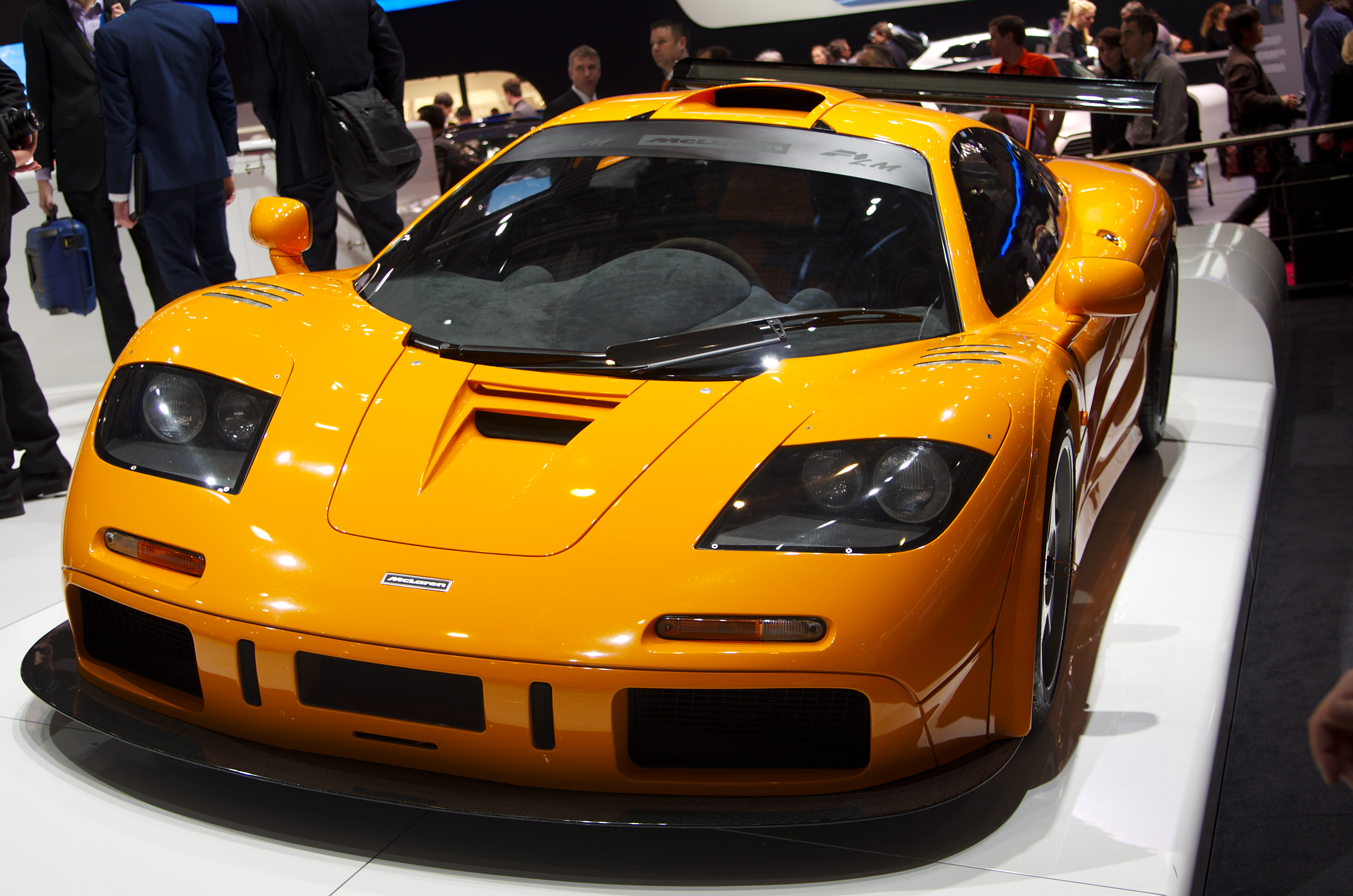
McLaren F1 LM in Papaya Orange at the Geneva Motor Show 2013
Photo: Clément Bucco-Lechat · CC BY-SA 3.0 · Clément Bucco-Lechat, CC BY-SA 3.0, via Wikimedia Commons

THE ROAD CAR

McLaren F1 LM

A five-car celebration of the F1 GTR's 1995 Le Mans overall victory

On 18 June 1995, a McLaren F1 GTR driven by JJ Lehto, Yannick Dalmas and Masanori Sekiya won the 24 Hours of Le Mans outright — McLaren's first attempt and a result almost unthinkable on paper, with five F1 GTRs finishing in the top thirteen against purpose-built prototypes. Gordon Murray, who designed the original F1 as a road car with no racing intent at all, had reluctantly let the team be turned into a Le Mans entry. McLaren's response to the win was to build five road cars in tribute — one for each F1 GTR that finished the race.

The F1 LM took the same BMW S70/2 6.1-litre V12 engine as the F1 GTR but removed the air-restrictors that the regulations required for racing. Power rose to approximately 671 hp / 680 PS — the highest of any naturally aspirated V12 road car of its era — and weight dropped by approximately 76 kg compared to the standard road F1, to around 1,062 kg. The interior lost its noise insulation, audio system and almost any concession to comfort. The fan-assisted ground-effect underbody from the GTR was removed for road legality, but a fixed rear wing replaced the standard car's active aero.

All five F1 LMs were finished in Papaya Orange, McLaren's racing colour. A sixth car, the prototype XP1 LM, was built in 1995 and used by McLaren as a development mule and a test bed for higher-spec engine programmes; Murray himself drove it personally for years. Three of the original five F1 LMs went to the Sultan of Brunei. As of 2023, F1 LMs change hands at auction for figures upward of US$20 million when they appear at all — which is rarely; most owners do not sell.

Engine
BMW S70/2 6.1L naturally aspirated V12
Power
approx. 671 hp (680 PS)
Weight
approx. 1,062 kg
Years built
1995–1996 (5 cars + 1 XP prototype)

You've built it. Now display it.

Brix Plus stands are built around the exact dimensions of every LEGO® Speed Champions set — including this one. Made for collectors, by collectors.

Shop display stands →

Display ideas

  • Pair 76918 with 75892 McLaren Senna (6-stud, 2018) — three Papaya Orange McLarens spanning 1995, 2018 and 2022, all built around extreme philosophies.
  • Display alongside 77251 McLaren MCL38 to bracket McLaren's road-and-track range with its current F1 race programme.
  • Twin-podium display: F1 LM at the front in 1995 Le Mans pose; Solus GT slightly back, mirroring the way the two cars share McLaren Technology Centre's heritage gallery.

People

Two cars, three generations of McLaren engineering and design — and the customer programmes that funded both.

Gordon Murray

DESIGNER · McLaren F1

Murray designed the McLaren F1 from a clean sheet between 1988 and 1992, with a road-car-first remit and no plans to race it. After Larbre Compétition and Ray Bellm convinced McLaren to build the F1 GTR, Murray oversaw the racing programme that won Le Mans first time out in 1995. The F1 LM is essentially Murray's celebration of that result — a road-legal version of the de-restricted GTR, finished in McLaren racing orange.

Peter Stevens

DESIGNER · McLaren F1 EXTERIOR

Stevens was the exterior designer of the McLaren F1, working alongside Murray on the central-driving-position three-seat layout and the BMW V12-powered package. He's also responsible for the F1 LM's distinctive fixed rear wing and the cosmetic differentiation from the standard road F1 — much of which read as a direct nod to the GTR's 1995 Le Mans body kit.

Rob Melville

DESIGN DIRECTOR · McLaren Automotive

Melville led the design team that turned the 2017 Vision Gran Turismo digital concept into the production Solus GT, between 2020 and 2022. The brief he set himself was to keep the silhouette, the single-seat closed-cockpit cabin and the digital-era aerodynamic surfaces almost unchanged from the video-game car — so the road-going object that emerged is unusually faithful to its virtual ancestor.

Andy Palmer

PROGRAMME DIRECTOR · McLaren Special Operations

Palmer ran the Solus GT customer programme out of McLaren Special Operations — the bespoke division that also handled commissions like the Speedtail, Elva and Sabre. His job covered the seat-fitting, race-suit and helmet programme, on-track driver coaching, and the bespoke trailer-and-storage offer that came with each of the 25 cars. The Solus GT is the most extreme car MSO has signed off to date.

The build

581 pieces, two cars, age 9+

76918 is a dual-vehicle set with 581 pieces, rated 9+. Each car is approximately 15 cm long when built, so they sit at the same scale as their single-vehicle wave-mates. The F1 LM is finished in McLaren Papaya Orange (the production cars' actual colour), with the F1 logos and the 1995 Le Mans-spec graphics applied as stickers. The Solus GT carries McLaren's modern racing livery — predominantly orange with black accents — and includes a transparent canopy element for the closed cockpit, which is one of the harder elements to translate at 8-stud scale.

Build highlights

The build features were designed by LEGO® designer Chris Stamp, who also designed several other McLaren Speed Champions sets in the 8-stud era. The F1 LM's three-seat central-driving-position cabin is captured at scale (the brick model retains a single visible cockpit position even though the real F1 has three seats). The Solus GT retains its halo, exposed front wheels and roof-mounted air intake. Each car comes with a removable cockpit cover that snaps onto a 4×6 plate, plus a driver minifigure with a printed helmet. Reviewers consistently flag the F1 LM as the more accomplished of the two — the Solus GT's challenging shapes are harder to capture in brick.

Where it sits in the McLaren collection

76918 was the third McLaren dual-vehicle set in the 8-stud era, after 76902 McLaren Elva (single car, 2021) and 76910 Aston Martin Valkyrie & Vantage GT3 (the same dual-vehicle template applied to a different brand). Together with 75892 McLaren Senna (6-stud, 2018) and 76902, it represents McLaren's hypercar arc through the LEGO® Speed Champions catalogue — Senna, Elva, then F1 LM and Solus GT bracketing it at either end of the range.

Minifigures

The set includes two McLaren driver minifigures — one in modern orange-and-black race overalls for the Solus GT, with a contemporary Speed Champions racing helmet, and one in mid-1990s McLaren racing colours for the F1 LM, with a period-style helmet. Both minifigures are generic team drivers and not specific real-driver likenesses. McLaren has consistently declined to put real driver names or faces on Speed Champions minifigures.

FAQ

Is LEGO® set 76918 still available?
Released on 1 March 2023 at US$34.99 / £39.99 / €39.99 / A$69.99. As of the 2026-04-24 availability check, LEGO.com no longer lists 76918 as in-stock — Brickset records it as retired in 2025. Aftermarket prices are tracking upward.
How big are the cars in LEGO® set 76918 when built?
Each of the two cars is approximately 15 cm long built. The model package is 35.4 × 19.1 × 7 cm. Both cars sit at the same 8-stud scale as the rest of the wave.
How many pieces does LEGO® set 76918 have?
581 pieces, plus two McLaren driver minifigures — one for each car.
Which McLaren is which in LEGO® set 76918?
Two cars: the 1995 McLaren F1 LM (a road car finished in Papaya Orange, built to celebrate the F1 GTR's 1995 Le Mans victory — five customer cars made) and the 2022 McLaren Solus GT (a track-only single-seat V10 hypercar limited to 25 units, originally a Gran Turismo Sport video-game concept).
Why are these two cars together in one LEGO® set?
Because both are McLaren "celebration cars" — extreme, customer-only McLarens built to mark a non-commercial milestone. The F1 LM celebrates the F1 GTR's 1995 Le Mans victory; the Solus GT celebrates a McLaren video-game concept that customers asked McLaren to actually build. Neither was on McLaren's product roadmap. They sit 27 years apart but share the same brand instinct.
Is this a 6-stud or 8-stud LEGO® Speed Champions set?
8-stud. 76918 is from the current LEGO® Speed Champions scale, which began in 2020.
What other LEGO® McLaren Speed Champions sets are there?
8-stud era: 76902 McLaren Elva (2021), 76918 McLaren Solus GT & F1 LM (2023), 77251 McLaren F1 Team MCL38 Race Car (2025), 77257 McLaren W1 (2026). 6-stud era: 75892 McLaren Senna (2018), 75880 McLaren 720S (2017), 30343 McLaren Mercedes (polybag, 2018). The 8-stud McLaren range is one of the most active in Speed Champions.

Related sets

Keep browsing

step through the McLaren range, or see what else dropped in 2023.

Sources

  1. LEGO.com — primary
  2. Brickset — primary
  3. Rebrickable — primary
  4. Jay's Brick Blog — other
  5. McLaren Automotive — primary
  6. Wikipedia — wikipedia
  7. Wikipedia — wikipedia
  8. Wikipedia — wikipedia
  9. 24 Heures du Mans — primary
  10. Wikimedia Commons — wikipedia
  11. Wikimedia Commons — wikipedia