
Browse by era
Two eras of LEGO® Speed Champions: 6-stud and 8-stud.
In 2020 LEGO® widened the standard Speed Champions car from six studs to eight. It looks like a small change. It is not. Every set built since runs on different proportions, different driver-cabin geometry, and a different parts inventory.
38
6-stud sets
67
8-stud sets
106
Total
2020
Transition year
From the line's launch in 2015 through 2019, every Speed Champions car was six studs wide. That measurement governed everything: how many wheels would fit under the body, how the driver's minifigure sat in the cabin, how the front and rear lights were graphically printed. The format was tight and the cars looked like cartoon proportions of their real counterparts.
In 2020 LEGO® widened the standard car to eight studs and lengthened the chassis. The cabin became a proper two-seater. Wheelbases grew. Most importantly, the body had room for accurate side intakes, real shoulder lines, and printed badges in the right proportions. The 8-stud cars look like models. The 6-stud cars look like toys.
For collectors the era split is the most-important piece of metadata after price. A 6-stud Mustang and an 8-stud Mustang are not interchangeable on a display shelf — they're different scales, different design languages, and they don't pose well next to each other. The eras are also where most rebrickable parts-compatibility questions arise: a 6-stud chassis plate doesn't accept an 8-stud body. Several brands re-released the same nameplate across the line — there's a 6-stud Bugatti Chiron and an 8-stud Vision GT, two Ferrari F40s, two McLaren Elvas — and each pair sits in a different era.
Case study: the same car, two eras
LEGO® has rendered the Ferrari F40 in Speed Champions twice — once in each era. Five years apart, same iconic car, two different design languages. If you want to see what the 2020 widening actually changed, this is the cleanest like-for-like in the line.
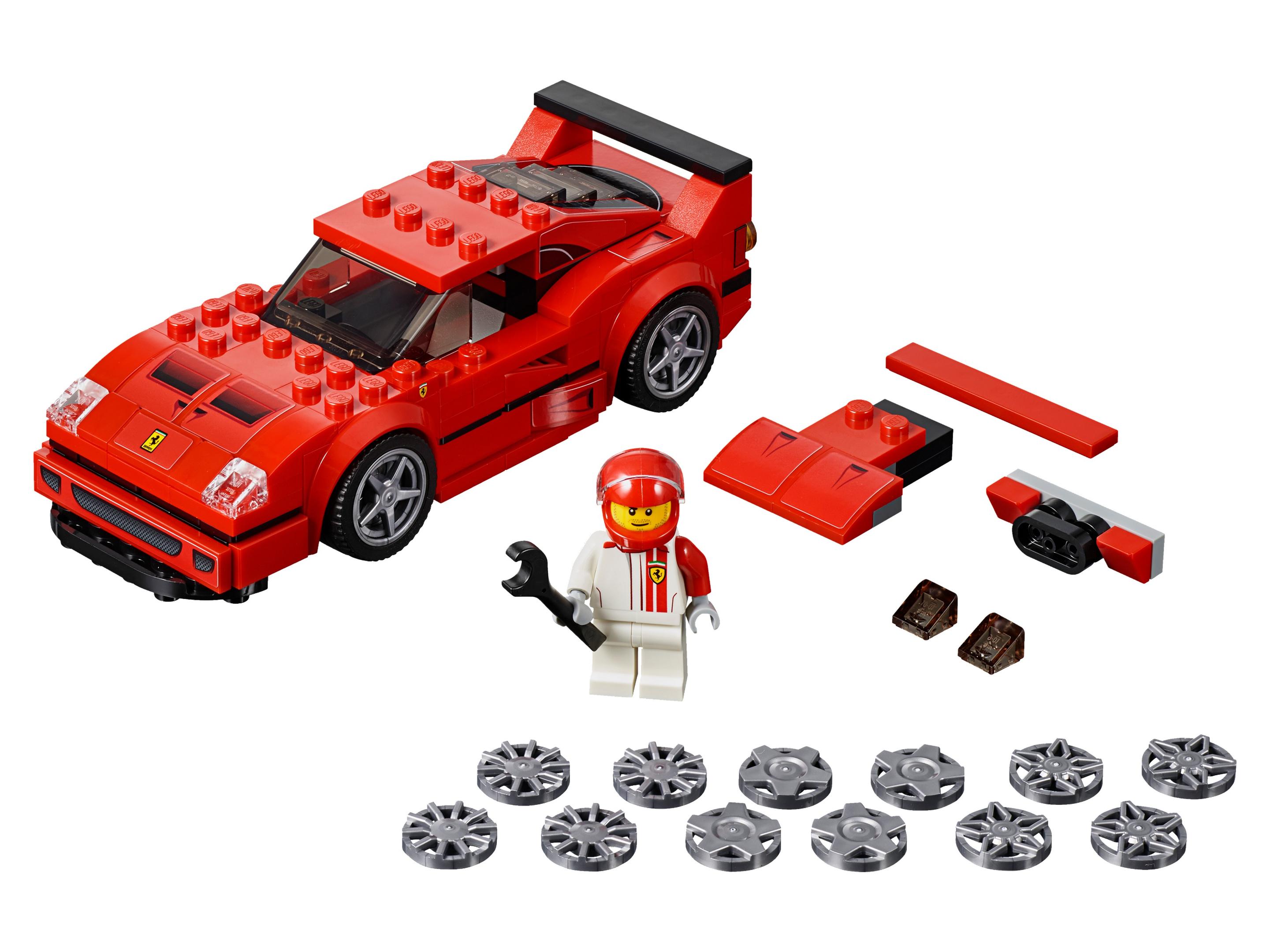
6-Stud · 2019 · 200 pieces
75890 — F40 Competizione
The track variant. Released in 2019 — the final year of the 6-stud era — and built to the original narrower format. Cabin tight, body short, stickered detailing.
View 75890 →
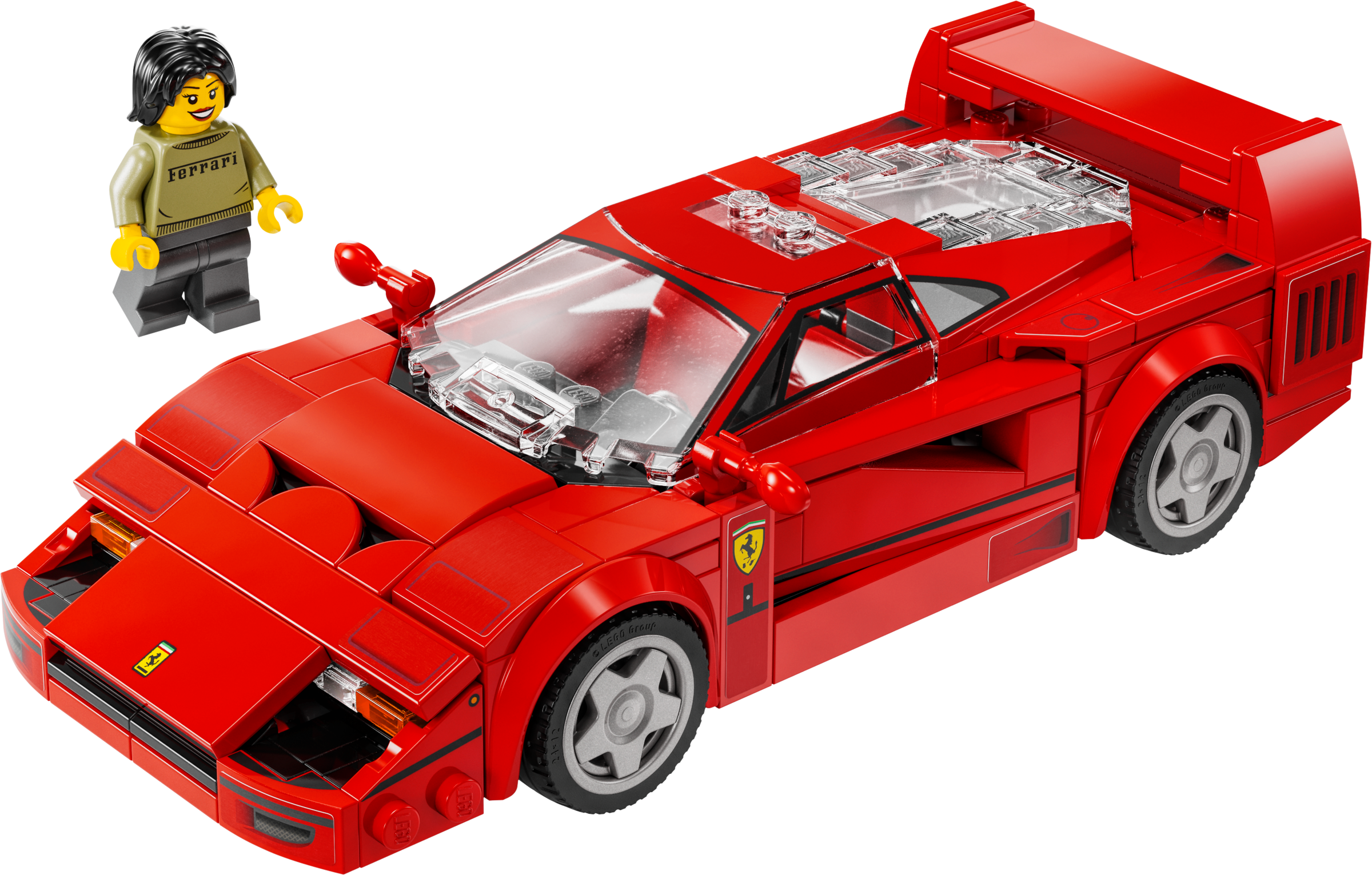
8-Stud · 2024 · 318 pieces
76934 — F40 Supercar
The road car. Wider track, longer wheelbase, two-seat cabin, printed badges and taillights instead of stickers. The proportions read F40 from any angle.
View 76934 →
The two F40s aren't substitutes. They're a pair. 75890 is the Competizione — the track-prepped LM/GTE variant Ferrari built in single-digit numbers. 76934 is the road car Enzo signed off on in 1987, the 201-mph 40th-anniversary celebration. Same silhouette, different missions. LEGO® reached the limit of what 6-stud could express with the Competizione, then came back five years later with the road car at modern scale.
The piece count tells the story bluntly: 318 vs 200, sixty percent more parts for the same car. Most of that growth is in the body. The 6-stud F40 has stickers where the 8-stud has printed parts; the cabin fits one driver tightly where the 8-stud sits two; the wheelbase is shorter than the real F40's iconic stance, where the 8-stud is in proportion. The 8-stud doesn't replace the 6-stud — it's a different model of a different version of the same car. Both are correct, in their own era's design language.
For Ferrari completionists this is the cleanest pair to chase. For everyone else it's the easiest way to see, side by side, what changed in 2020 and why it mattered. The Competizione is retired, and the road car is on the LEGO® retirement watchlist — so the window to assemble the pair from new boxes is closing.
The two eras
2015–2019
6-Stud Era
The launch generation. 38 sets across five model years. Tight-format cars, cartoonish proportions, the design language LEGO® used to test whether the line had a market at all.
Browse 6-stud sets →
2020–present
8-Stud Era
The mature line. 67 sets and counting. Longer chassis, two-seat cabins, accurate side intakes, printed-badge details. The era where Speed Champions became a serious display-model line.
Browse 8-stud sets →
Other ways to browse
Browse by
Brand
Every car maker — Ferrari, Porsche, McLaren, and ten more.
Browse by
Theme
Editorial groupings — film cars, JDM icons, F1 grids, hypercar trios.
Browse by
Category
Road cars, race cars, hypercars, F1, endurance — what each set actually is.
Browse by
Year
Every model year, 2015–2026 — sets-per-year graph and headline build for each.