Film-IP build
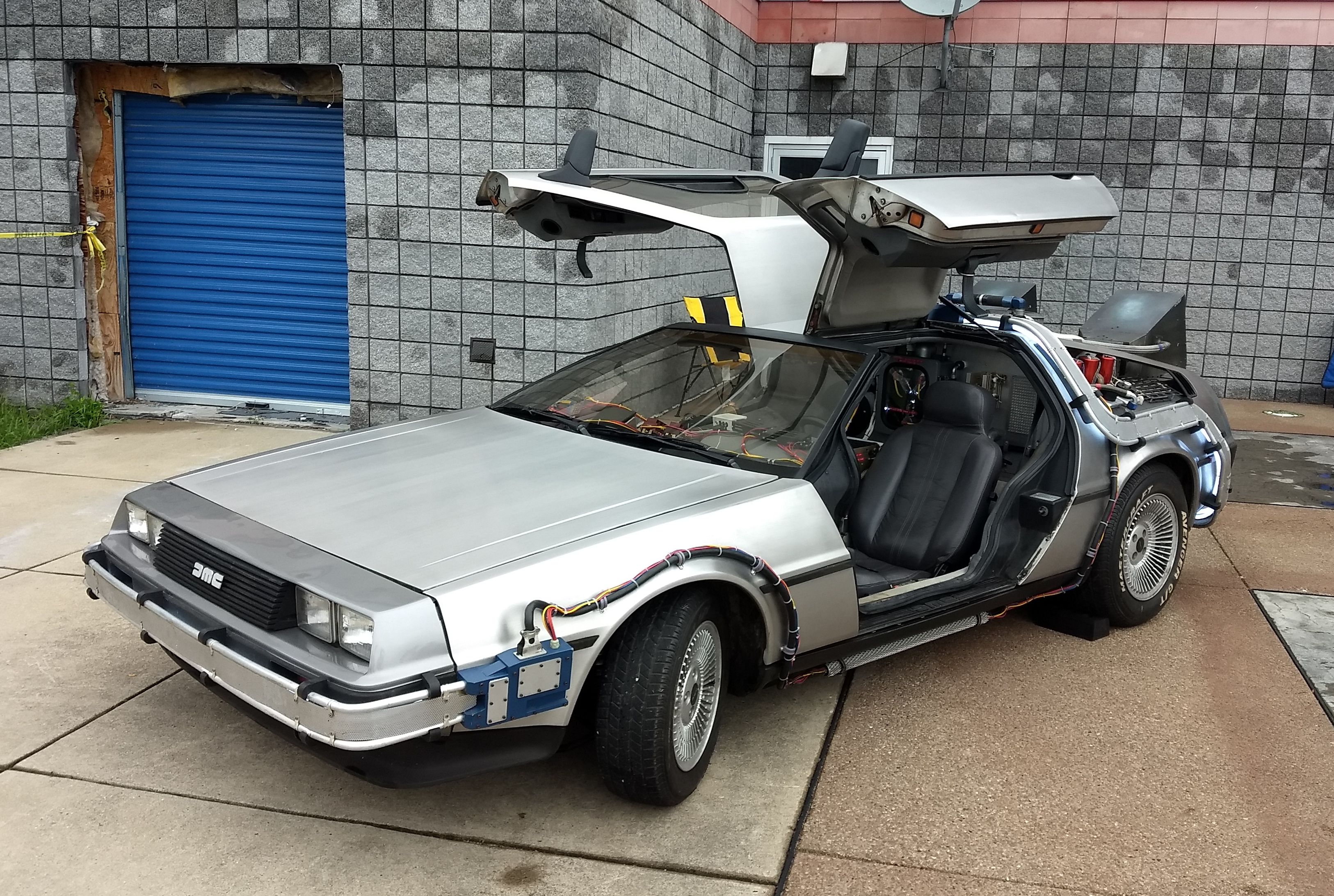
DeLorean DMC-12 Time Machine
Built on a real production car; transformed by Doc Brown in the 1985 film
The real DeLorean DMC-12 is the work of three people who never worked in the same room. John DeLorean — a former GM executive who ran Pontiac and Chevrolet before leaving to start his own sports-car company — chose the stainless-steel body and named the company after himself. Giorgetto Giugiaro's Italdesign studio shaped the wedge silhouette and the gullwing doors. Colin Chapman's Lotus team engineered the chassis and drivetrain around a 2.85-litre PRV (Peugeot-Renault-Volvo) V6 mounted at the rear, making 130 bhp at 5,500 rpm — respectable for 1981, but not the exotic performance the car's shape suggested.
Production ran from January 1981 to late 1982 out of a purpose-built factory in Dunmurry, Northern Ireland. Roughly 9,000 cars were built before the company collapsed amid financial and legal scandal. The DMC-12 should have been a footnote — a low-volume cult car remembered for its doors and its litigation — and for three years, it was.
Then in 1985, Robert Zemeckis and Bob Gale's time-travel comedy cast the DeLorean as the Time Machine. The script originally called for the machine to be built inside a refrigerator; Gale has said in multiple interviews that he rejected that because the gullwing-door DeLorean 'looked like a UFO', which made it plausible that farmer Peabody might mistake it for a spacecraft in the second film. The car's unlikely shape — already commercially unlucky — became its defining property. Today, surviving DMC-12s trade well above their original price almost entirely because of the film.
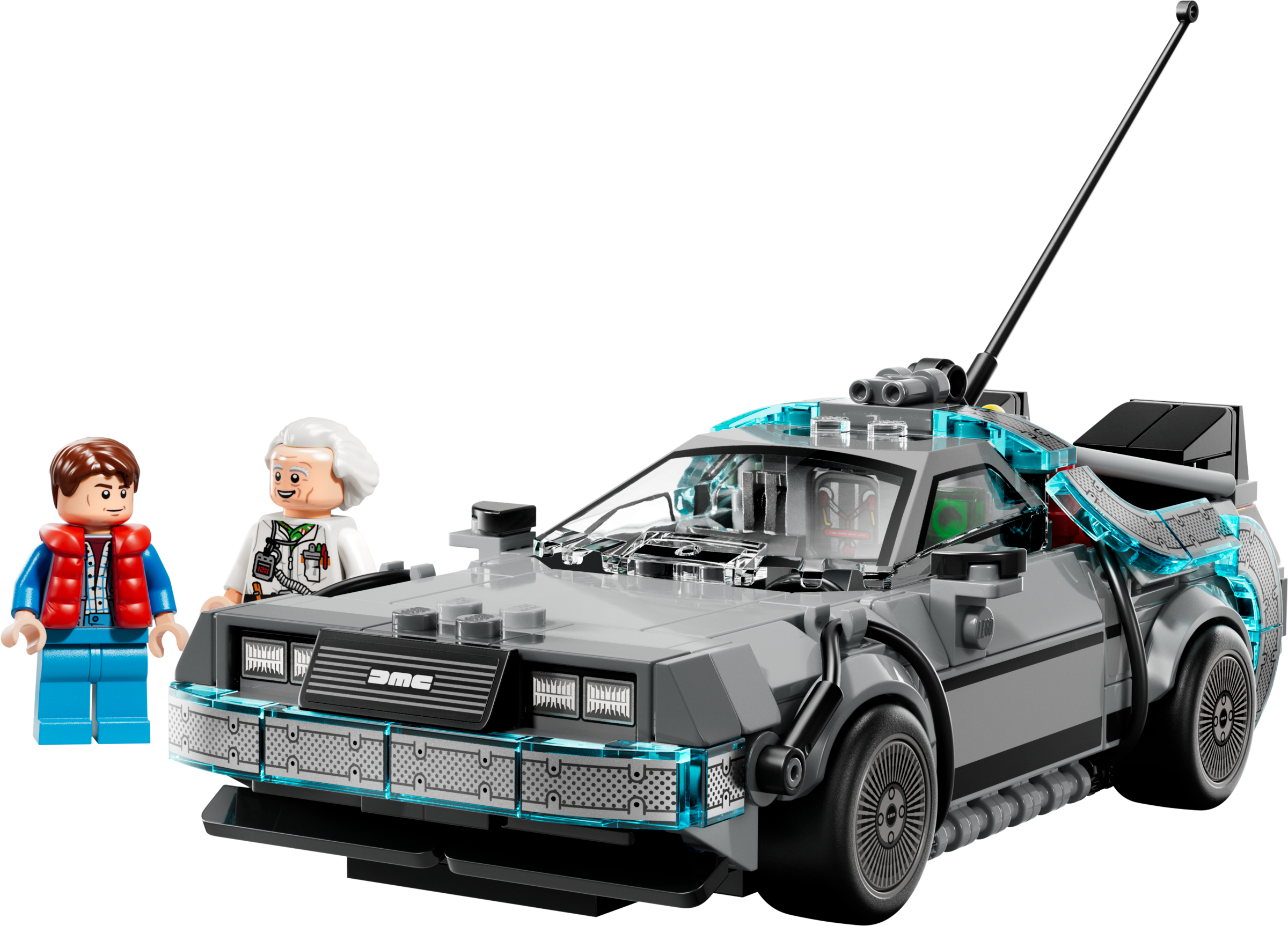
77256 rebuilds the film prop rather than the road car: the stainless-steel body is implied by the LEGO® palette, but the detail work is the movie's, not DeLorean's. Trans-blue flux-capacitor bands, time-circuit panels, a hinged lightning rod that comes off in flight mode, and sideways wheels for the Part II flying conversion are all the work of the production designers — not Giugiaro.
- Designer (real car)
- Giorgetto Giugiaro, Italdesign
- Engineering (real car)
- Colin Chapman, Lotus Cars
- Engine
- 2.85 L PRV V6, rear-mounted, 130 bhp at 5,500 rpm
- Transmission
- 5-speed manual
- Production run
- ~9,000 units, 1981–1982, Dunmurry (Northern Ireland)
- Film debut
- Back to the Future (1985), dir. Robert Zemeckis