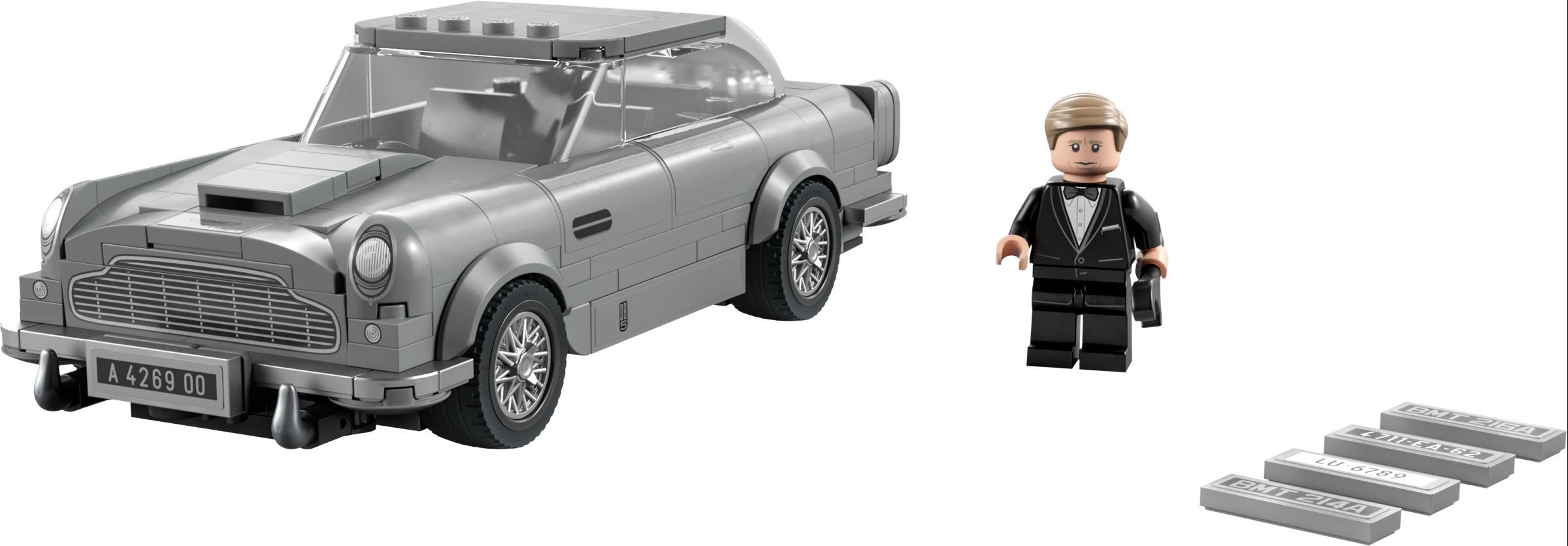

THE ROAD CAR
Aston Martin DB5
Aston Martin's 1963 grand tourer — and Bond's car since Goldfinger.
The DB5 entered production in July 1963 as an evolution of the DB4 Series V, with a 4.0-litre version of Tadek Marek's twin-cam straight-six (3,995 cc, 282 bhp standard or 325 bhp Vantage) replacing the DB4's 3.7. The aluminium body, designed in Milan by Federico Formenti at Carrozzeria Touring Superleggera, used Touring's Superleggera technique — small-diameter steel tubing skinned in hand-formed aluminium panels — built under licence at Aston's Newport Pagnell works. The five-speed ZF manual gearbox was new; the optional three-speed Borg-Warner automatic was carried over.
Just 1,059 production DB5s left the factory between July 1963 and September 1965 (plus 65 Vantages, 123 convertibles and 13 Harold Radford shooting brakes), making it one of Aston's lowest-volume regular-production models. A further 25 Goldfinger Continuation cars were hand-built between 2020 and 2022 to the original specification, complete with working gadget replicas — the project that re-anchored the DB5 in Aston Martin's modern catalogue and likely cleared the licensing path for the LEGO® 76911 set.
The Goldfinger connection started with a phone call to Aston Martin in 1963: Eon Productions wanted a DB5 for a film, and special-effects supervisor John Stears took delivery of two prototypes — one for principal photography, one for the gag rig. Stears engineered the revolving plates, the ejector seat, the bullet shield and the machine guns into a working car. When the LEGO® 76911 set ships five pairs of number plates and a printed dashboard panel, it is reproducing the most consequential prop modification in twentieth-century cinema.
- Engine
- 4.0 L (3,995 cc) Tadek Marek DOHC inline-six
- Power
- 282 bhp standard / 325 bhp Vantage
- Top speed
- 145 mph (233 km/h)
- Years built
- 1963–1965 (1,059 cars + 25 Continuation 2020–22)