Speed Champions · 2026

Lightning McQueen

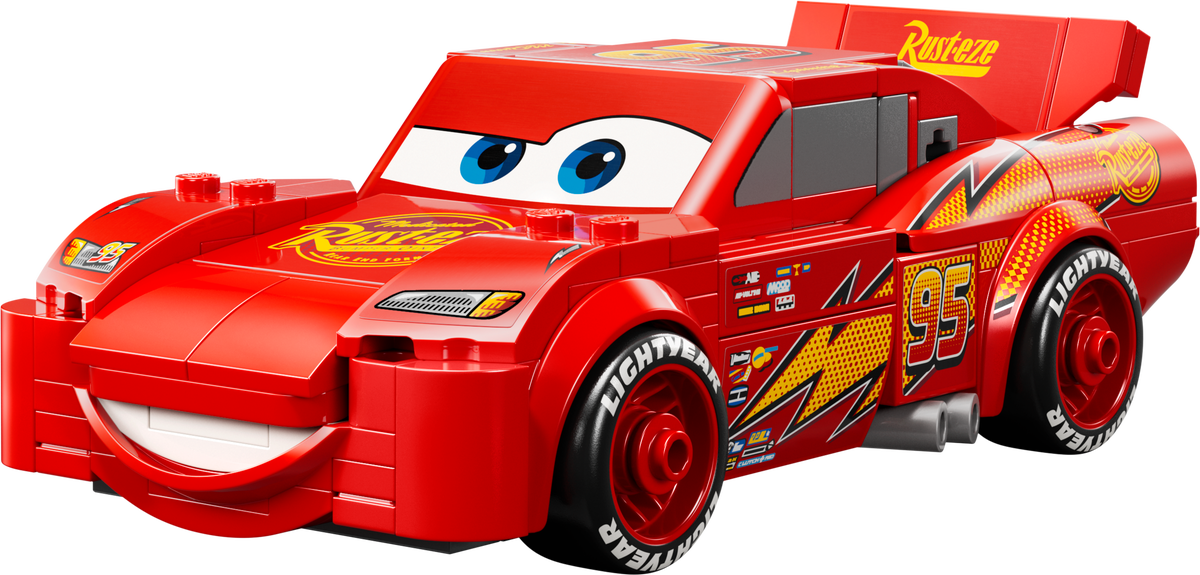
The first Speed Champions set designed without a driver — because the car IS the driver.

Set #77255 2026 270 pieces 8-stud Current

Released on 1 January 2026 to mark the 20th anniversary of Pixar's Cars (2006), 77255 is the first LEGO® Speed Champions set built around a fully fictional vehicle — and the first to ship without a minifigure. That omission is deliberate: in the Cars universe there are no humans, so a driver would break the fiction. With the minifig cockpit removed from the budget, designers redirected the parts count into a brick-built underbelly with exhaust pipes and a visible driveshaft — a first for the line — plus a small, almost hidden joke: a brick structure behind the windshield that reads, from above, as McQueen's anthropomorphic eyes and brain.

LEGO® Speed Champions 77255 Lightning McQueen, 270 pieces, in the red-and-yellow 95 livery from Pixar's Cars.
77255 — Lightning McQueen, 270 pieces, 2026.

Browse this set's coordinates

Compare with another set →
Share
A physical 1:1-scale Lightning McQueen replica on display at the Petersen Automotive Museum in Los Angeles, showing the red paint, Rust-eze sponsor livery, and the number 95 on the roof and door.
Photo: TaurusEmerald · CC BY-SA 4.0 · the 1:1-scale Lightning McQueen display replica at the Petersen Automotive Museum, Los Angeles
Film-IP build

Lightning McQueen

Fictional character vehicle — composite design based on real stock cars and sports cars

Lightning McQueen is not a real car and never has been. That matters for a LEGO® Speed Champions set, because every other set in the theme rebuilds something you could in principle walk up to in a car park. 77255 rebuilds a character — a CGI race car first rendered for Pixar's Cars (2006), voiced across all three films (2006, 2011, 2017) by Owen Wilson, and still the face of a franchise twenty years later.

The design wasn't pulled from thin air. Production designer Bob Pauley has said in studio interviews that McQueen's silhouette is a composite of a NASCAR Generation 4 stock car (the proportion of the greenhouse, the stance) and more curvaceous sports cars — specifically the Ford GT40, the Lola T70, and the 2006 Chevrolet Corvette C6, with grille cues borrowed from the 2006 Dodge Charger SRT-8. John Lasseter, who directed the first two films, is a known classic-car enthusiast; the real-car composite approach was his idea, on the principle that every Cars character should read as a specific make and era even if the logos never appear on screen.

The number 95 on McQueen's door is a Pixar reference, not a racing one. 95 is the release year of Pixar's first feature film, Toy Story (1995). The Rust-eze sponsor livery, the lightning-bolt graphic, and the headlight-stickers-on-a-closed-front-end (because the original Piston Cup cars are stock-car-style closed-eye prototypes) all date from the 2006 design. The character's appearance has been tweaked across Cars 2 and Cars 3 — flame details in Cars 2, a matte-finish makeover near the end of Cars 3 — but 77255 uses the classic 2006 livery.

The Petersen Automotive Museum in Los Angeles keeps a full-scale Lightning McQueen replica on permanent display. It is hand-built on a custom chassis, roughly the proportions of a modern NASCAR, and is the closest object in the physical world to a 'real' McQueen. That is the photograph at the top of this section — the car that inspired the brick, such as it is.

Character debut
Cars (2006), dir. John Lasseter, Pixar Animation Studios
Voice actor
Owen Wilson (Cars, Cars 2, Cars 3)
Design references (per Bob Pauley)
NASCAR Gen 4 stock-car silhouette; Corvette C6 grille cues; Ford GT40 and Lola T70 curves; Dodge Charger SRT-8 front-end detail
Race number
95 — references Toy Story's 1995 release
Sponsor (in-universe)
Rust-eze Medicated Bumper Ointment
Real-world display
1:1-scale replica at the Petersen Automotive Museum, Los Angeles
Get set 77255

Build it in one sitting — 270 pieces across five numbered bags — then photograph it from above. The windshield joke doesn't land from the side; the whole design logic is top-down.

Buy on LEGO.com

Display ideas

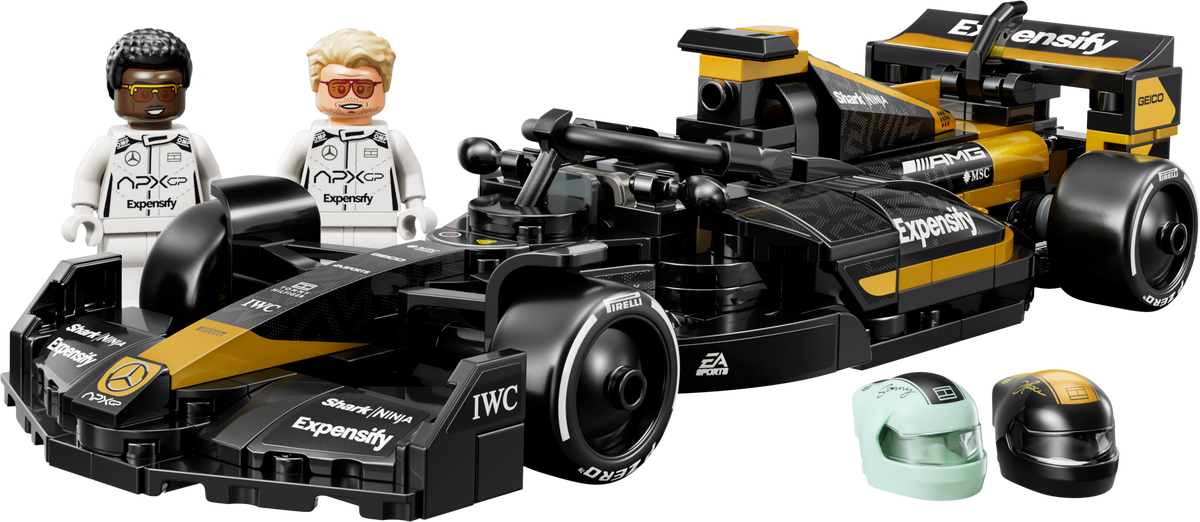
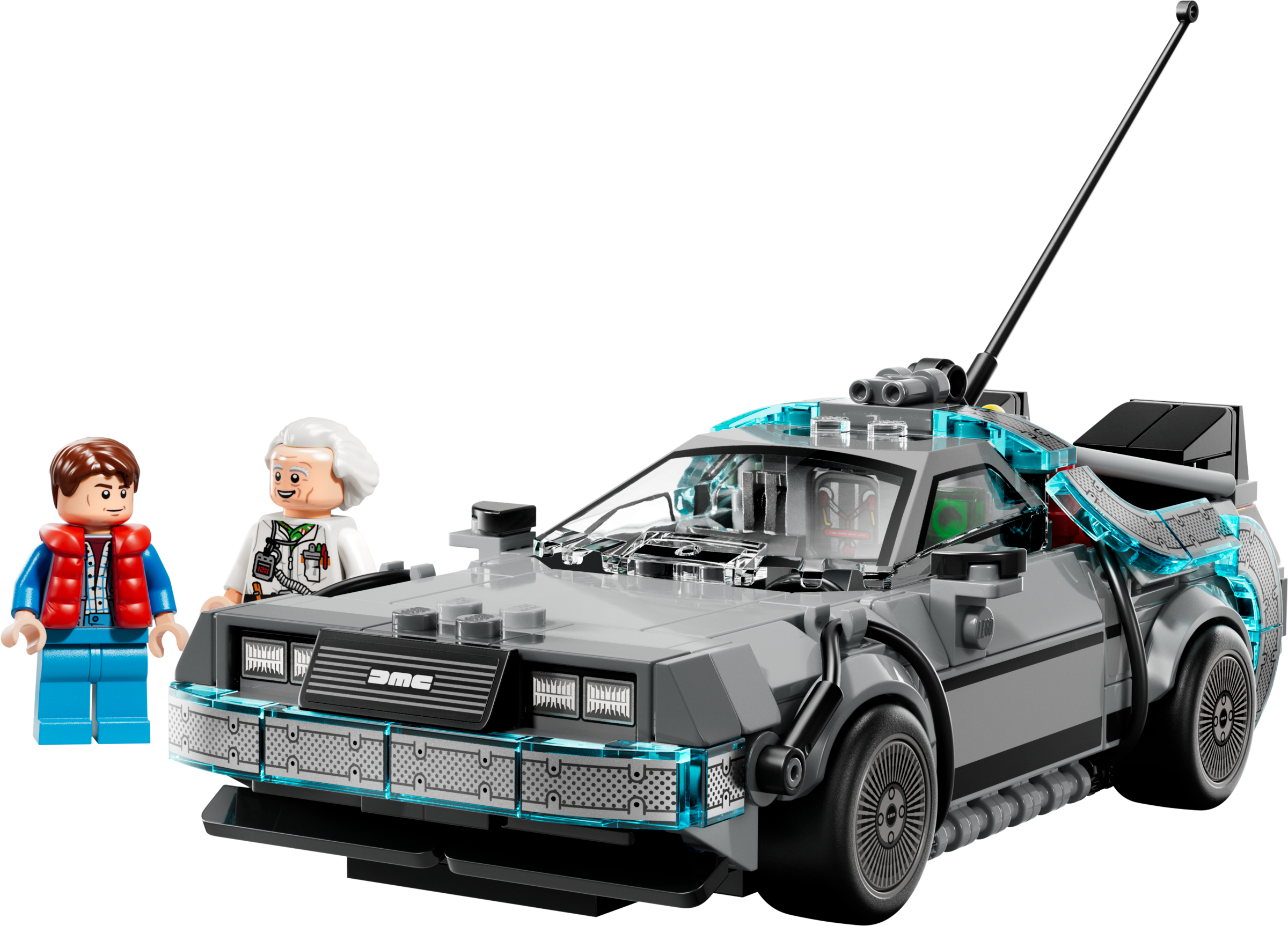
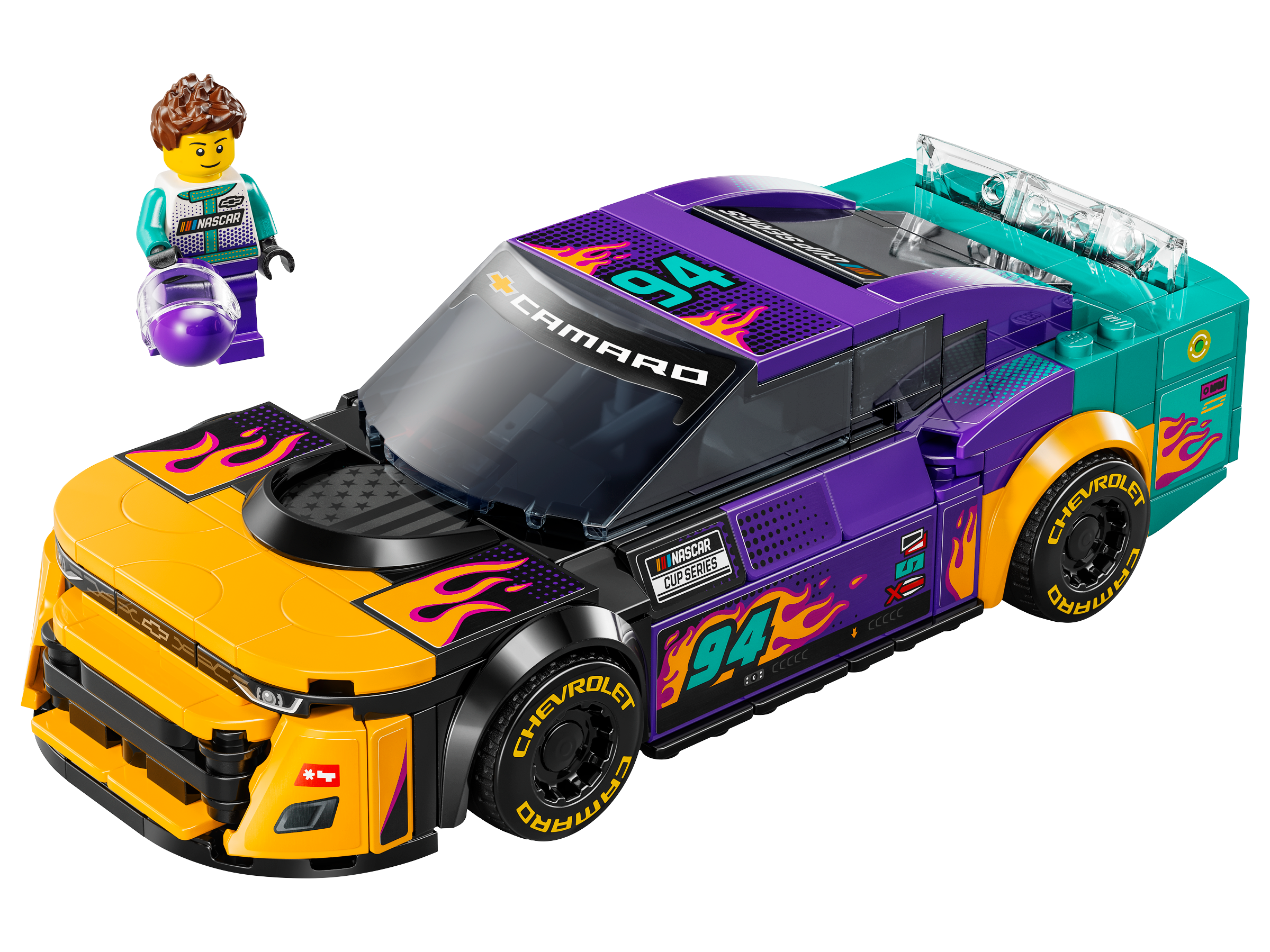
  • Shelve alongside 77256 Time Machine and 77252 APXGP for a 2026 'cars from films' cluster — three licensed sets, three different kinds of fictional vehicle.
  • Pair with 42205 Lightning McQueen Road Trip (Disney Pixar Juniors) for a scale comparison if you have younger builders in the house.
  • Photograph from above on a Radiator Springs-style asphalt backdrop to show the roof livery and windshield brain detail — the side view hides the set's best features.

People

Because the car is fictional, the people worth naming here are the Pixar team who designed him — plus the actor whose voice the character has carried for two decades.

John Lasseter

Director, Cars (2006) and Cars 2 (2011)

Bob Pauley

Production designer, Cars (2006)

Owen Wilson

Voice of Lightning McQueen

The LEGO® Speed Champions design team

Model designers, 77255 (2026)

The build

Why there's no minifigure

The first Speed Champions underbelly

New elements and the sticker trade-off

FAQ

Is LEGO® set 77255 still available?
Released on 1 January 2026 at US$27.99 / £22.99 / €27.99. As of the 2026-04-24 availability check, LEGO.com still lists 77255 as current.
Why doesn't 77255 come with a minifigure?
Because in Disney Pixar's Cars universe, cars are the characters — there are no humans. LEGO® designers have said omitting the driver also freed the structural budget for a fully detailed underbelly with brick-built exhaust pipes and a driveshaft, and for a small 'brain' detail visible through the windshield from above. 77255 is the first LEGO® Speed Champions set to ship without a minifigure.
What real car is Lightning McQueen based on?
There isn't one. McQueen is a composite. Per Pixar production designer Bob Pauley, the character was built from the NASCAR Generation 4 stock-car silhouette, the Corvette C6 grille, the curves of the Ford GT40 and Lola T70, and the front-end detail of the 2006 Dodge Charger SRT-8. The Petersen Automotive Museum in Los Angeles displays a 1:1 replica built on a custom chassis, which is the nearest physical object to a 'real' McQueen.
What does the number 95 mean?
It's a Pixar reference, not a racing one. 95 is the year Pixar's first feature film — Toy Story — was released (1995). John Lasseter's fingerprints are all over the choice: he directed Cars and was a senior creative at Pixar through the Toy Story era.
How many pieces does 77255 have, and how big is it?
270 pieces per Rebrickable and Brickset inventories, across five numbered bags. LEGO.com lists the finished model at roughly 14 cm long — consistent with the 2024–2026 Speed Champions wave at 8-stud scale. No minifigures; no included display base.
How does 77255 fit into the rest of Speed Champions?
It's part of the 2026 film- and franchise-licensed wave alongside 77256 Time Machine (Back to the Future) and 77252 APXGP (F1 The Movie). Speed Champions has done real-brand race and road cars for a decade; 77255, 77256 and 77252 together mark the line's clearest push into pop-culture IP. 77255 is the oddest of the three — it's the only set where the vehicle never existed in the real world at all.

Related sets

Keep browsing

step through the Fictional & Movie Cars range, or see what else dropped in 2026.

Sources

  1. Rebrickable
  2. LEGO.com
  3. Jay's Brick Blog
  4. New Elementary
  5. Wikipedia
  6. Wikipedia
  7. Wikimedia Commons
  8. Petersen Automotive Museum
  9. TopSpeed
  10. GM Authority
  11. Brickset