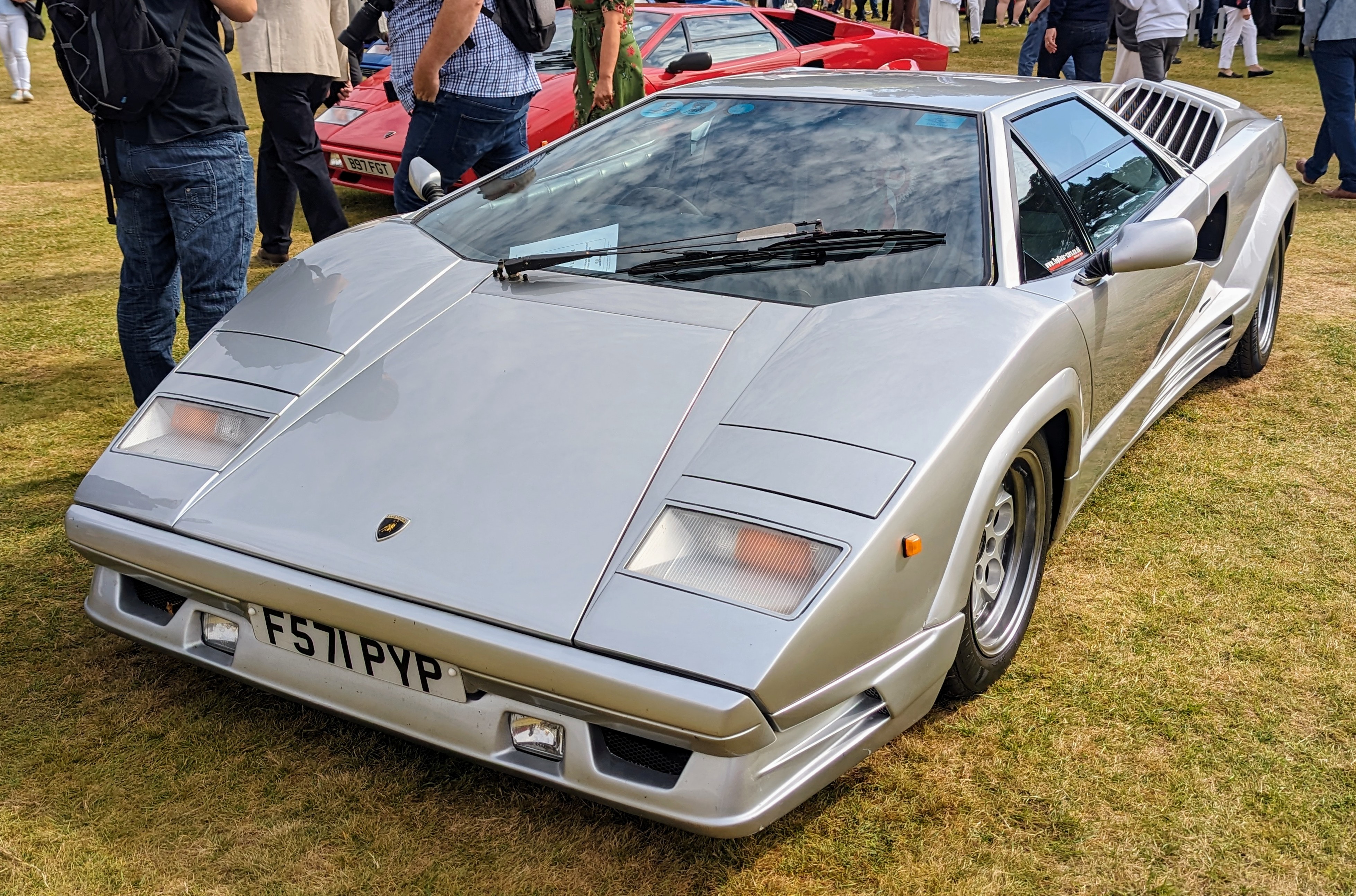
THE ROAD CAR
Lamborghini Countach
2,049 built across 16 years. Five variants. One silhouette.
The Countach's design history begins with Bertone's LP500 prototype, unveiled at the 1971 Geneva Motor Show. Marcello Gandini, then in his late 20s, drew the car around chief engineer Paolo Stanzani's longitudinal mid-mounted V12 layout (the LP in the project name stood for 'longitudinale posteriore'). The name Countach is a Piedmontese exclamation Gandini's design team used at first sight of the prototype.
Production began in 1974 with the LP400, the purest of the Countach line — narrow tyres, no fender flares, no rear wing, 375 hp from a 3.9-litre V12. The 1978 LP400 S widened the arches and added the optional V-shaped rear wing that became the car's most enduring visual signature. The 1982 LP500 S grew the engine to 4.8 litres; the 1985 5000 Quattrovalvole added four-valve heads and pushed power into the 450 hp range; the 1988 25th Anniversario, restyled by a young Horacio Pagani, is the version with the body-coloured side strakes and reshaped intakes.
Total production was 2,049 cars across all five variants over sixteen years. Mid-engine V12 layout throughout. Top speed peaked at around 290 km/h (180 mph) for the QV and 25th Anniversary. The Countach was Lamborghini's flagship for the entire late-1970s and 1980s; it was succeeded in 1990 by the Diablo, also styled by Marcello Gandini.
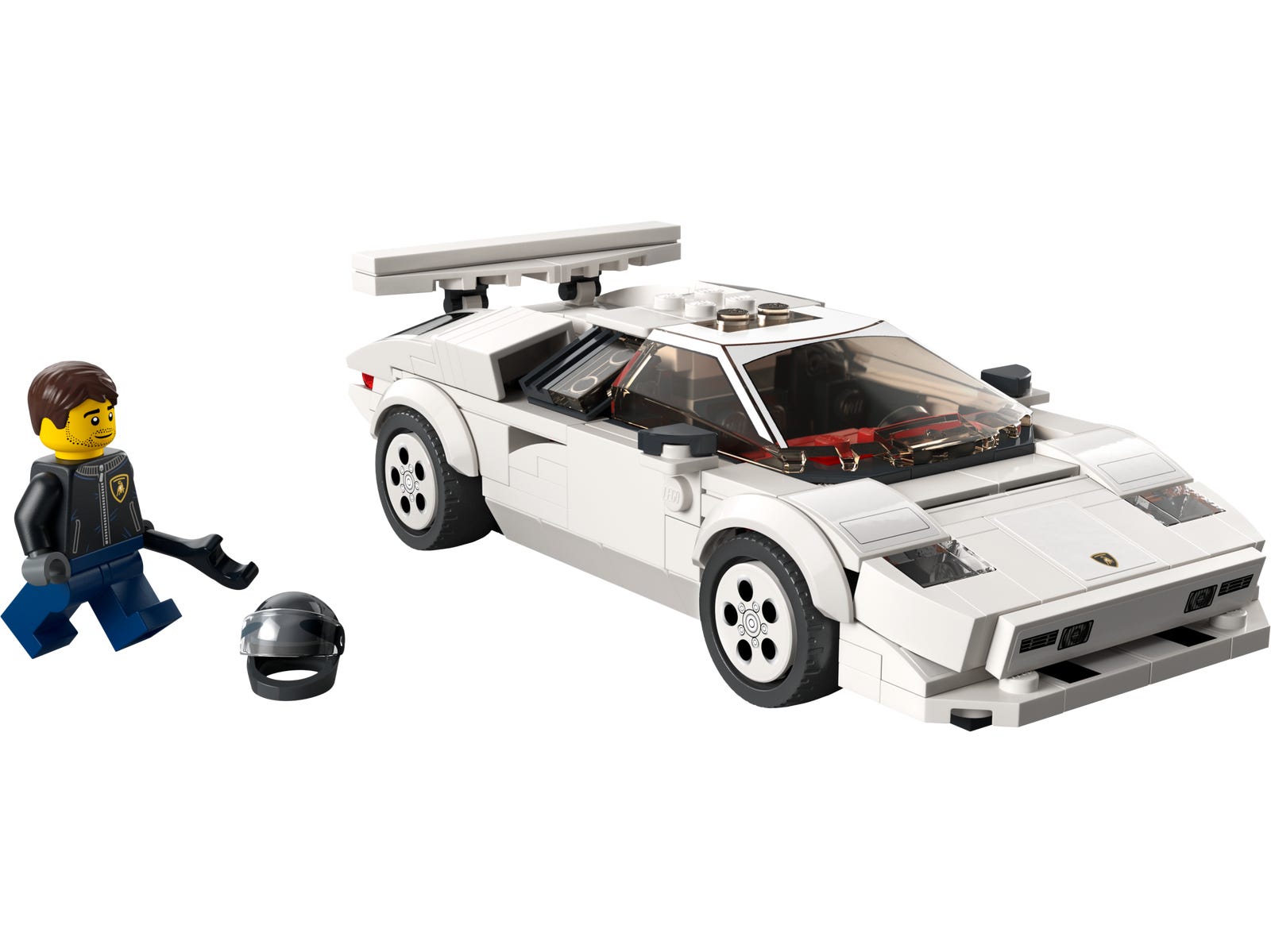
The Countach also has the unusual distinction of having defined the cultural concept of 'supercar' as much as any single car. The 1980s bedroom poster of a red Countach is its own genre. The 2021 Countach LPI 800-4 — built in 112 units — is Lamborghini's modern homage to the original; like the LEGO® set 76908, it deliberately quotes the LP400's pure wedge.
- Engine
- Mid-mounted V12, 3.9 to 5.2 L (variant-dependent)
- Power
- 375 hp (LP400) to ~450 hp (5000 QV / 25th Anniversario)
- Top speed
- ~290 km/h (180 mph) at peak
- Years built
- 1974–1990, 2,049 units across 5 variants