LEGO® Speed Champions · Ferrari · 2024

Ferrari F40 Supercar

Enzo's last road car, finally in modern 8-stud LEGO® — five years after the Competizione track variant, and retiring from LEGO® shelves on 31 July 2026.

Set #76934 2024 318 pieces 8-stud Current

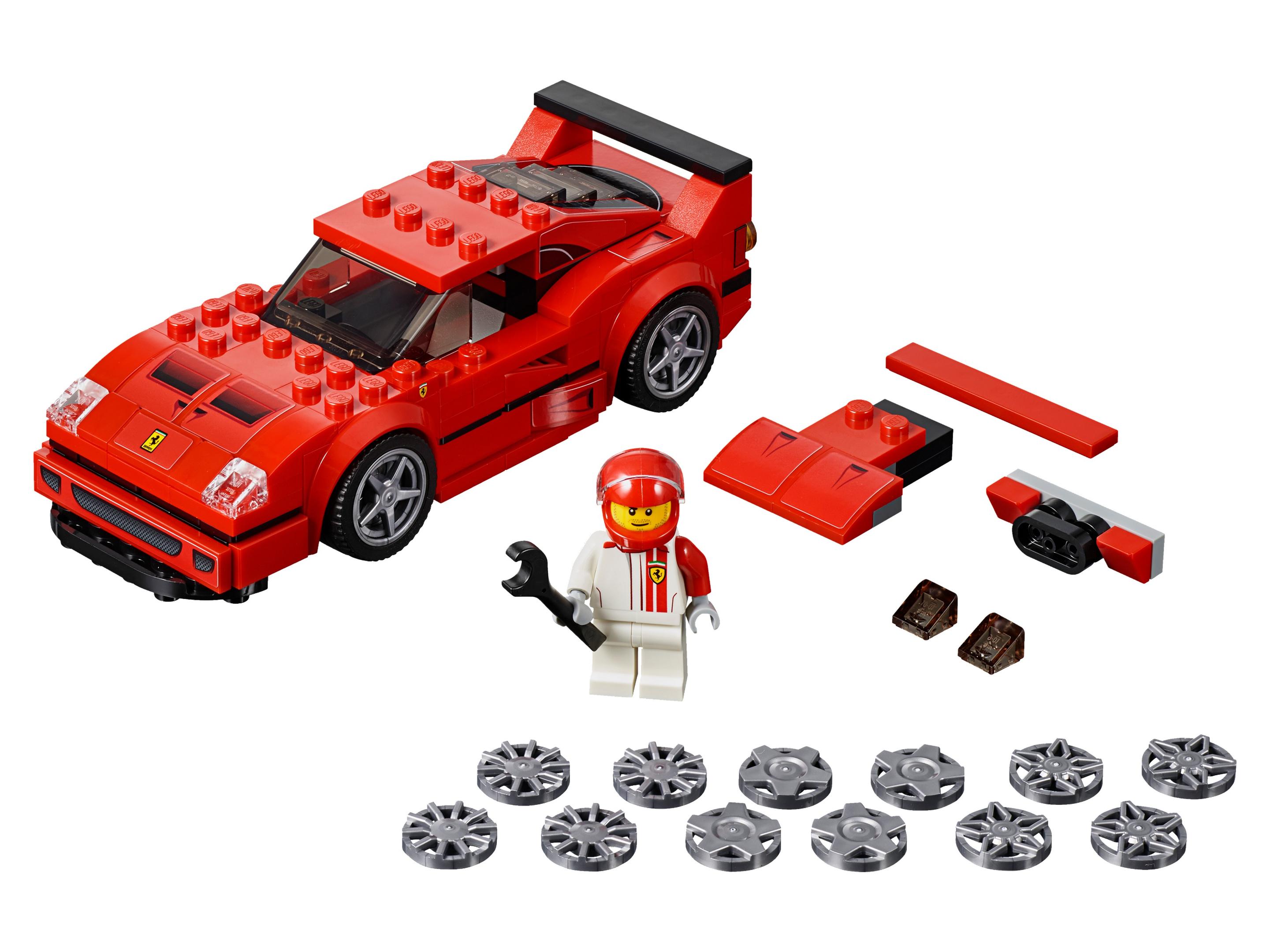
The Ferrari F40 has been rendered in LEGO® Speed Champions twice. The first, set 75890 in 2019, was the F40 Competizione — the race-prepped track car, built in the original narrower 6-stud scale. Set 76934, released in August 2024, finally gives the road-going F40 the modern 8-stud treatment: wider track, more refined curves, printed parts instead of stickers, and a silhouette that reads as F40 from any angle. If you already own 75890, this is the road-car counterpart that completes the story. If you don't, this is the F40 to buy — and it's on a clock, with LEGO® scheduled to retire the set on 31 July 2026.

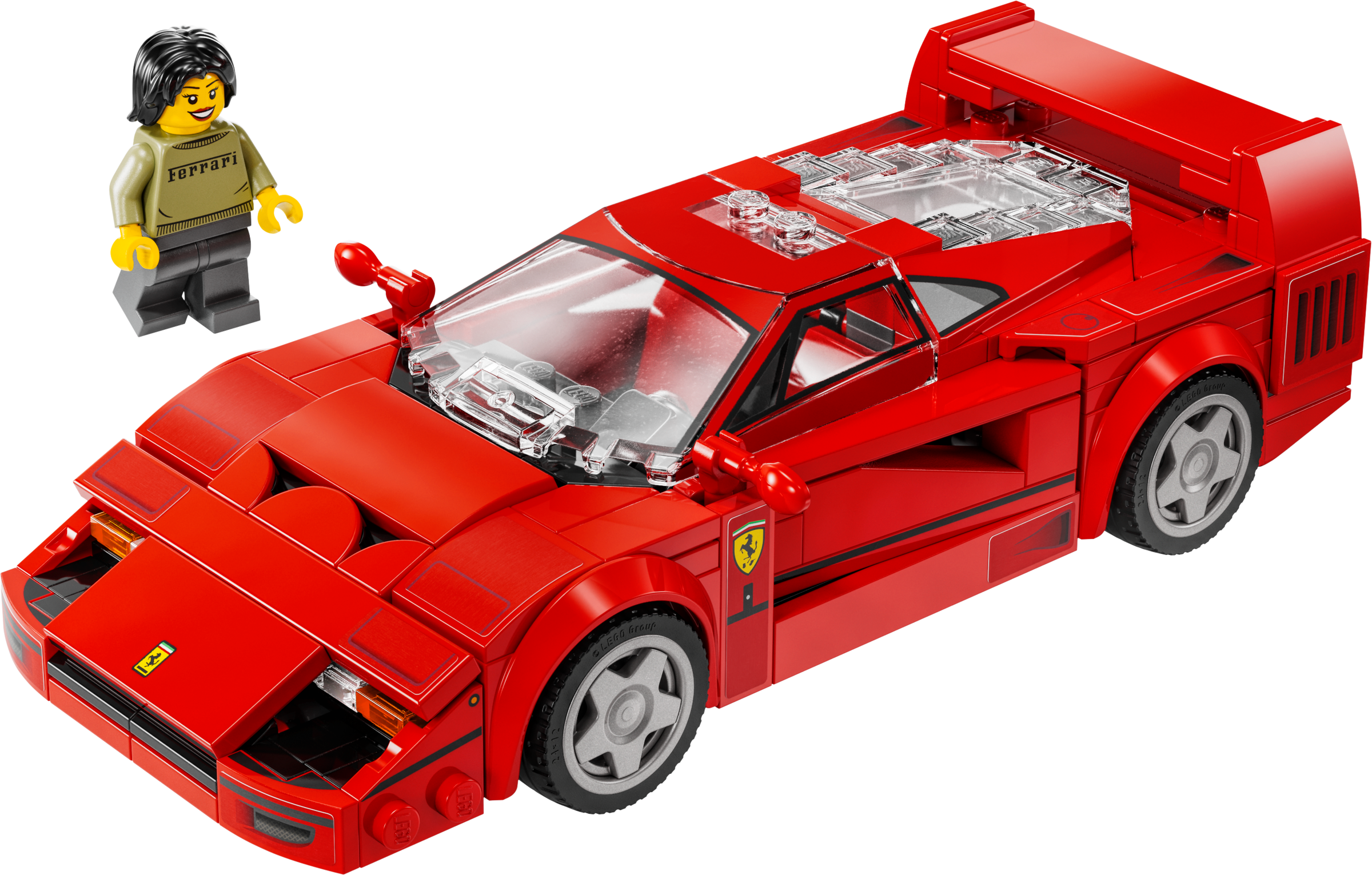
LEGO® Speed Champions set 76934 Ferrari F40 Supercar, product image showing the assembled red F40 with Ferrari driver minifigure
Image: Rebrickable catalogue

Browse this set's coordinates

Compare with another set →
Share

There is only one car in this box — the road-car F40 that Enzo Ferrari personally approved as the company's 40th-anniversary halo model. Here's why it matters, and what Nicola Materazzi and Pininfarina did to get it built in twelve months.

1989 Ferrari F40 photographed at a classic-car event
Photo: MrWalkr · CC BY-SA 4.0 · 1989 Ferrari F40 at a classic-car meet, June 2024.

THE ROAD CAR

Ferrari F40

Enzo's 40th-anniversary supercar, the first street-legal production car to clear 200 mph.

The F40 started as a paper napkin. In June 1986, Enzo Ferrari — then 88 years old and already terminally ill — asked his chief engineer Nicola Materazzi for a car that would mark the company's 40th anniversary and remind the world what Ferrari meant. Materazzi had one condition: he got to build it the way he wanted. He got twelve months.

What Materazzi built was a production-homologated evolution of the 288 GTO Evoluzione Group B programme that had been cancelled when the FIA killed Group B. He kept the 2.9-litre twin-turbo V8, bored it out to 2,936 cc, pushed it to 478 bhp, and hung it behind the driver in a composite-and-steel monocoque with a Kevlar-reinforced body designed by Pininfarina. There was no ABS, no power steering, no stability control, and no carpet — Ferrari offered sliding Lexan side windows as a weight-saving option over wind-up glass.

On 21 July 1987, the F40 was unveiled at Ferrari's Civic Centre in Maranello. Enzo called it "the last Ferrari" — he died thirteen months later. The car became the first street-legal production car to exceed 200 mph (321 km/h), built 1,311 times between 1987 and 1992, and remains the Ferrari that most directly carries Enzo's own fingerprints. Every F40 that has come since — the F50, the Enzo, the LaFerrari, the F80 — is in some sense a response to it.

Engine
2,936 cc twin-turbo V8
Power
478 bhp @ 7,000 rpm
Top speed
201 mph (324 km/h)
Years built
1987–1992 · 1,311 cars

You've built it. Now display it.

Brix Plus stands are built around the exact dimensions of every LEGO® Speed Champions set — including 76934. Made for collectors, by collectors.

Shop display stands →

Display ideas

  • <strong>Pair it with 75890.</strong> Side-by-side with the 2019 F40 Competizione, you get a before-and-after of Speed Champions scale (6-stud vs 8-stud) and a before-and-after of the F40 itself (road vs track).
  • <strong>Build the Ferrari lineage.</strong> Line 76934 up with 76914 Ferrari 812 Competizione and 76895 Ferrari F8 Tributo — three generations of front- and mid-engined Ferrari road cars.
  • <strong>Put it at eye level.</strong> The rear-wing silhouette is the F40's strongest angle — display on a shelf at seated eye height so the spoiler is read against the horizon, not against the shelf above.

People

The F40 is one of the last cars where the story of how it got built is as famous as the car. Four names, and a deadline.

Enzo Ferrari

THE FOUNDER · APPROVED IT

Enzo greenlit the F40 in June 1986 as a 40th-anniversary statement and a response to the 959 Porsche had just released. He was 88, ill, and knew he wouldn't see many more cars. He approved the final prototype personally — the only F40 ever signed off by its namesake — and died on 14 August 1988, thirteen months after the public launch. The F40 is the last Ferrari Enzo ever put his name to.

Nicola Materazzi

CHIEF ENGINEER · BUILT IT IN 12 MONTHS

Materazzi had already built the 288 GTO and its stillborn Group B Evoluzione derivative. When Enzo asked for a halo car, Materazzi pitched the Evoluzione project as the base — fastest path to a finished car, and no wasted engineering. The twelve-month development timeline is now one of the most-cited deadlines in supercar history. Materazzi later said the F40 was "the car I had in my head the whole time."

Leonardo Fioravanti

PININFARINA · OVERSAW THE DESIGN

Fioravanti led Pininfarina's design direction on the F40. He was already a legend of the house — the Daytona, the 365 GT4 BB, the 288 GTO, the Testarossa — and brought a consistent vocabulary to the F40's silhouette, even though the line drawings were the work of his team. The F40 is the terminal point of Fioravanti's Ferrari career.

Pietro Camardella

PININFARINA · THE PRIMARY DESIGNER

Camardella, then a young designer at Pininfarina, did the actual line work on the F40 under Fioravanti and supervisor Aldo Brovarone. The car's proportions — the long tail, the NACA ducts, the low nose with the deep chin — are his. It is the design most directly associated with his name.

Aldo Brovarone

PININFARINA · SUPERVISOR · PLACED THE SPOILER

Brovarone was the senior supervisor on the project. The single most visually defining decision on the F40 — the giant rear wing mounted at exactly ninety degrees to the tail, instead of raked forward — is his. It's why the F40 reads as an F40 from the back, and it's the detail the 8-stud LEGO® version most obviously has to nail.

The build

Scale and era

76934 was released in August 2024 — squarely in the 8-stud era of LEGO® Speed Champions. The line moved from 6-stud to 8-stud in 2020, and every set since has been the wider, more detailed modern scale. That matters here because the F40 has been done before in LEGO®: set 75890 Ferrari F40 Competizione from 2019 is a 6-stud render of the track-spec F40, narrower overall and more reliant on stickers. 76934 is the long-awaited 8-stud road-car counterpart, and the two sets side by side tell the story of how the category evolved.

Build highlights

The 8-stud width gives the F40 room to breathe. The rear deck carries the cooling louvres as a recognisable feature rather than a sticker; the NACA ducts on the flanks are moulded elements; the rear wing sits clear of the bodywork with correct proportions. The front splitter and the deep chin are printed parts, not decals — a direct response to long-running complaints about 6-stud era Speed Champions sets.

The signature detail — Brovarone's right-angle spoiler — is the first thing to check when the model is assembled. Compared to the 75890 track-spec Competizione, 76934's stance is taller and more road-oriented, with production-correct wheels and a less aggressive front air dam. It is unmistakably the road car.

What the 318 pieces buys you

318 pieces puts 76934 in the middle of the modern Speed Champions range — smaller than the two-vehicle sets (which typically sit at 560–780 pieces) but substantial for a solo car. The build is age 9+, rated an hour to complete for an adult, and produces a model around 16.2 cm long — comparable to a 1:26 scale die-cast. It's a display piece first and a playable one second; the wheels roll, the doors don't open.

The set includes one minifigure: a Ferrari F40 Driver in red race suit with the Ferrari prancing-horse torso print. Pair it with 75890 on the same shelf and you have both sides of the F40 story — road and track — in LEGO®.

Minifigures

One minifigure: the Ferrari F40 Driver in a red Ferrari race suit. It's the only minifig in the box — a deliberate scaling-down from the two-figure driver+crew sets that Speed Champions sometimes includes.

FAQ

Is LEGO® set 76934 still available?
Released on 1 March 2024 at US$26.99 / £22.99 / €26.99. As of the 2026-04-24 availability check, LEGO.com still lists 76934 as current.
How big is the LEGO® Ferrari F40 Supercar when built?
The built model is approximately 16.2 cm long × 4.4 cm wide × 8.4 cm tall — the same footprint as a standard 8-stud Speed Champions car. Box dimensions match. The model is age 9+ and takes around an hour to build.
How many pieces does LEGO® set 76934 have?
318 pieces, plus one Ferrari F40 Driver minifigure.
How is 76934 different from 75890 Ferrari F40 Competizione?
Three differences. First, scale: 75890 is a 2019 6-stud set (narrower, original Speed Champions proportions); 76934 is a 2024 8-stud set (wider, modern proportions). Second, variant: 75890 is the F40 Competizione, the racing-prep track car; 76934 is the road-legal production F40 that Ferrari actually sold. Third, parts quality: 75890 relies more on stickers for details (splitter, graphics); 76934 uses printed parts for the signature decoration. They're designed to sit next to each other on a shelf.
Is this a 6-stud or 8-stud LEGO® Speed Champions set?
8-stud. 76934 is a 2024 release and sits firmly in the modern 8-stud Speed Champions scale. LEGO® shifted from 6-stud to 8-stud in 2020; every Speed Champions set from 2020 onward is 8-stud.
What other LEGO® Ferrari Speed Champions sets are there?
In the 8-stud era: 76914 Ferrari 812 Competizione (2023), 76895 Ferrari F8 Tributo (2020), and 77242 Ferrari SF-24 F1 Race Car (2025). In the 6-stud era: 75890 F40 Competizione (2019), 75899 Ferrari LaFerrari (2015), and 75886 Ferrari 488 GT3 (2018). Verify current availability on Brickset.

Related sets

Keep browsing

step through the Ferrari range, or see what else dropped in 2024.

Sources

  1. Rebrickable
  2. Brickset
  3. Wikipedia
  4. Wikipedia
  5. Wikipedia
  6. Wikimedia Commons